
Interview with a Priest
February 19, 2017
An engaging interview with Priest Lloyd Keane of Black Rivers Pylon. Enjoy!
Sentinel of the Bull of Ombos Pylon of the Temple of Set.
An engaging interview with Priest Lloyd Keane of Black Rivers Pylon. Enjoy!


The relationship between art and magic has always been a close one. Both deal in the act of creation; of bringing forth something from Self, and it’s not surprising that many Black Magicians are also artists, musicians, or writers of some kind. Some artists who probably aren’t involved in the occult can still provide inspiration and insight to Black Magicians. Andy Warhol is one such artist, and recently the Bull of Ombos Pylon convened and took a trip to the Blanton Museum here in Austin, to see the “By The Book” Warhol exhibit. The focus of this particular presentation of Warhol’s work was his contributions to books, and the art on display is pulled from every era of the artist’s career. Visitors would see his early work – the shoe drawings, his pre-fame illustrations for children’s books, and other whimsical pieces. One room had the artist’s famous screen tests projecting onto a wall, filling the area with black and white close up footage of many of his Factory superstars. Faces, and the preservation of those faces at a specific moment in time, were important to Warhol, and that becomes obvious looking at a retrospective of his work. The presentation of “By the Book” greets visitors with canvas after canvas, most of which seem to be filled with faces; most of which were instantly recognizable and iconic. Warhol took Polaroids to capture images of the famous people he painted, using the instant photos to create the types of silkscreened images the artist was most known for.
Warhol was interested in interesting people; in the famous and potentially famous. The artist helped exalt his Factory superstars, taking his entourage of oddball bohemians and giving them 15 minutes of fame. As Black Magicians, we find Initiatory value in preservation of the Self, of magnifying our most pure and refined essence. This is no secret to anyone on an Initiatory path, and one can find many parallels in Warhol’s work. He visually captured the essence of many of his subjects, creating a form of immortality that will live far beyond any of their lifespans. The “By the Book” exhibit is well worth viewing if one is a fan of Warhol’s work, but it also gives magicians much to consider. How we present ourselves, and what kind of permanent presence we create within the world is important always consider, and Warhol helped to cement not just his own legacy, but that of many of his subjects, and in a way more engaging than most other artists. His portraits and films still feel fresh and immediate, helping to craft the images of people who are still alive, while preserving the those of people who are not. It is a magical act not often bridged in art.

Tonight we have responses from Brother Virgil to our second round of interview questions.
1. How did you know your magic was working?
There were times when it didn’t, or at least seemed not to. Maybe my Balance Factor was off, or Lust of Result sabotaged my unseen hands behind the scenes. But I persevered, keeping in mind that magic is not an Easy Button. Magic is a skill, and like any true skill, you have to suck at it before you can become OK at it. When a basketball player misses a free throw, he doesn’t say “Welp, I shot a brick, so shooting a basketball doesn’t work.” He practices, corrects, and practices some more.
While in the routines of daily life I tend toward a secular and skeptical way of looking at things, but I find that when my magic really crackles, the results hit me like a Hurricane Kick across the face and remind me why I keep doing this. It often takes the form of unexpected plot twists, uncanny timing, and/or being in the right place at the right time in such a way that it’s almost like someone scripted the moment with my Desire in mind.
Interpreting the efficacy of one’s magic is largely a matter of recognizing patterns and connections over time. It is necessarily a subjective art – not a science – that takes one’s internal landscape, passions, and Desires into account. This makes it a hard sell in our superficially “secularized” and “rational” age (I can hear my fellow Americans laughing…). Subjective interpretation is not admissible to empirical study, for good reason. But magic is not empirical, nor reliably reproducible by different people doing or saying exactly the same things the same way. Every would-be magician must look within and find one’s own combination, one’s own style or method that works. To put it another way: if magic were science, then it would just be science.
2. What difficulties or sticking points did you experience during your First Degree period?
There were times I had to catch myself when I was going through the motions of what I “thought” a Black Magician should say, think, do, or believe. Having prided myself on outgrowing the conformity-centered culture of sameness and obedience to authority that I’d come from, it irked me to realize I was still susceptible to the all too human urge to mirror the crowd, even in small, subtle ways. It’s one thing to get the basic idea of the Left-Hand Path. It’s something else to gain the working Understanding that, no, it’s really not about black clothing, subcultural posturing, or compliance with any particular political checklist of pet issues. It’s about cutting away the parts of you that aren’t really you, until only the essential Self is left.
3. What was the strangest thing that happened to you as a First Degree? The most unexpected thing?
For whatever reason, I found that I had this bizarre talent for recognizing Setians in person as Setians, sight unseen, without even knowing who they really were. On my journey to my first International Conclave, there were at least three or four examples I can think of who I spotted in passing – at airports, in the streets, in the hotel lobby, even in nearby restaurants – and “noticed,” thinking maybe they might be going to the same place I was. All turned out to be Setian Initiates of varying degrees.

The following is the first installment to our second set of interview questions, answered by the Sentinel of the Bull of Ombos.
I would like to extend my gratitude to Priest Keane of Black Rivers Pylon for his collaboration in crafting these questions.
1. How did you know your magic was working?
There were two aspects to this realization. First was the obvious – I got the things I wanted. I performed magic based on desire for tangible objective things, and these things materialized.
The second was more subtle but arguably more important. I saw and felt a transformation take place within myself. I became more confident and courageous. I was evolving into the person I’d always wanted to be. I started to attract the right people, find the right places, and found that I could trust myself and my own intuition.
2. What difficulties or sticking points did you experience during your First Degree period?
The most difficult aspect of joining the Temple for me was learning to relate to myself, and certain parts of my world, in a new way. Experiences that may have once been petty annoyances could be transformed into an important step on my initiatory journey, but this required that I learn to work with them.
Also, I was in a thriving Pylon with people I had known socially for years, which meant we all had to reframe our relationships. This was another ongoing act of discipline and transformation.
3. What was the strangest thing that happened to you as a First Degree? The most unexpected thing?
The strangest thing that happened to me as a First Degree occurred within a month of joining the Temple (if memory serves, I had not yet received my welcome packet in the mail). I knew I was taking a big step…toward what, I wasn’t sure. I just knew that big changes were coming. I remember a distinct sense of possibility and potential, tinged with fear and uncertainty. There was just SO MUCH out there. I came home early from work one day, and was getting dressed to go on a date with my future husband, when I smelled something weird. I went into the hallway of my house and it was filled with smoke – an electrical fire! I saved my pets and called the fire department, but ended up living in a furnished apartment for several months while the house was cleaned and repaired.
That internal, subjective sense of uncertainty and liminality had manifested itself in my outer world. Just making sure I got the message, I guess!
The most unexpected thing that happened during my First Degree period was the confidence I began to feel. I was able to make changes to myself, to create myself. As a result of this, I became more attractive to more (and better) people, I was more equipped to practice discernment regarding who and what would further my Xeper, and I was able to ruthlessly remove negative influences from my life, without guilt. I started to find the strength to live as an antinomian.

The Black Rivers Pylon is one of the Temple of Set’s newest Pylons, based in Ottawa, ON. As the Temple’s oldest Pylon, The Bull of Ombos was happy to send its blessings on the night of the official opening of the Pylon’s gates. In the spirit of community and collaboration, Black Rivers has opted to pose our interview questions to its members.
The first of these posts can be found here.
The Sentinels of our two Pylons have worked together to craft a second set of interview questions, which will be coming soon.

Photo by Jorge Lascar
Brother Virgil is an esteemed member of the Bull of Ombos Pylon and a resident of Central Texas. His personal magical blog can be found At the Void’s Edge. He recently got back to me with his answer to one of my questions for our members.
Q: What do you recall of your earliest impressions of the Temple of Set?
A: At first all I had to go by was my initial correspondence with Setians, which more or less fit with what I had expected of them: intelligent, dignified, respectful, coherent, and generally approachable or friendly. I took it as a good sign, but also knew there could be no substitute for getting real, in-person interaction with these people to get a real sense of the caliber of individuals I was dealing with.
For many new Setians, this first contact comes from a one-on-one meeting during the initial interview process or soon after formal entry into the Temple. For others, it’s at a local (or at least nearby) Pylon meeting. But I never had any of that. It wasn’t until I’d hopped on a plane and flown to an International Conclave I encountered my first fellow Setians in person.
What struck me immediately was the ecclectic mix of “types” represented within the Temple. It wasn’t all goth rockabillies, all hipsters, all heavy metal dudes, all clean-cut professionals, or all bookish scholars, although all these types and more were present. But that to me just underlined what I had come to understand about Setian philosophy: It wasn’t a cultural or sub-cultural posture based on one particular aesthetic, style of dress, or other superficial means of constructed identity. Rather, the various characters I encountered represented an array of examples of what the Left-Hand Path can look like in practice, a multitude of expressions of common core principles.
I was also highly vigilant about any potential warning signs of “culty” behavior, cringey grandiosity, delusion, or general toxicity in the Temple membership. I’d read enough and judged my correspondence enough to pretty much be optimistic, but knew that people will still surprise you. Happily, I found that the Temple’s screening and interview process does a pretty good job of weeding out unsuitable persons early on. Those who get in and stay in are there for the same reason I am: a knowledge base, a toolset, and a network of like-minded individuals cooperating for mutual benefit on an as-needed basis.
To this day my fellow Initiates continue to inspire me.
Nestled in a residential neighborhood in South Austin, the Cathedral of Junk is an incredible folk-art creation with a distinctly Austin vibe. The Bull of Ombos Pylon recently spent some time at this monument to transmutation, using the unique energy which permeates every inch of the place as inspiration for our own Initiation. How might we use the “junk” in our own worlds, and transform it into a palace of our own? How can we transform lead into gold?


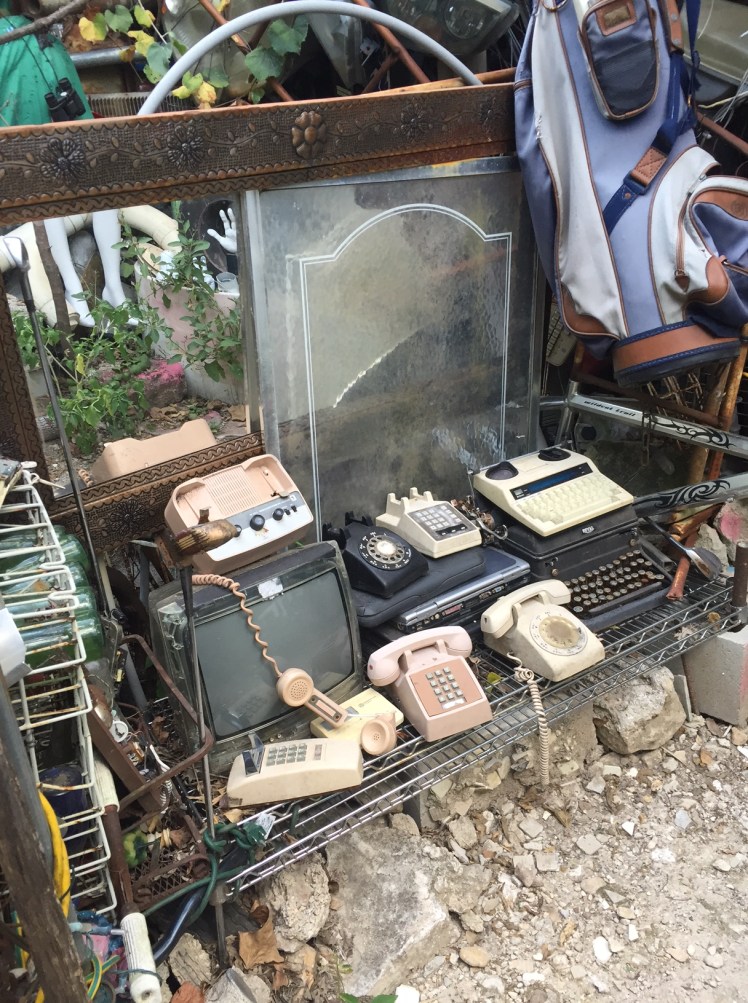


From Austin, it’s about a ninety minute drive northwest on smaller country roads, where the proper Hill Country starts to show itself. The town of Kingsland sits quietly on Lake LBJ, an unassuming country retreat.
Grand Central Cafe sits on the eastern side of town, a great little cafe inside a remodeled Victorian house. It’s a popular spot for Sunday brunch and holiday meals, where diners often come in from miles around. The space is well-appointed and the food is delicious.
And by the way, the house itself was the set of the 1974 film, The Texas Chainsaw Massacre.
In my experience, the staff are very open to talking about the house’s history, and there is even a plaque outside to commemorate its unique role in Texas film legend. The house was originally built in Round Rock, north of Austin, where it stayed until it was purchased, dismantled, and moved in 1998.
It’s too rare, in our experience, to see a community not only accepting, but celebrating their dark side. A visit to the Grand Central Cafe is a refreshing change of pace in that sense. Where else will you find an entire small town who decided to preserve a piece of horror film history, and turn it to their advantage?
A meal out at the Grand Central is well worth the drive, and a great way to show your support for those who appreciate the darker, weirder aspects of Texas history.
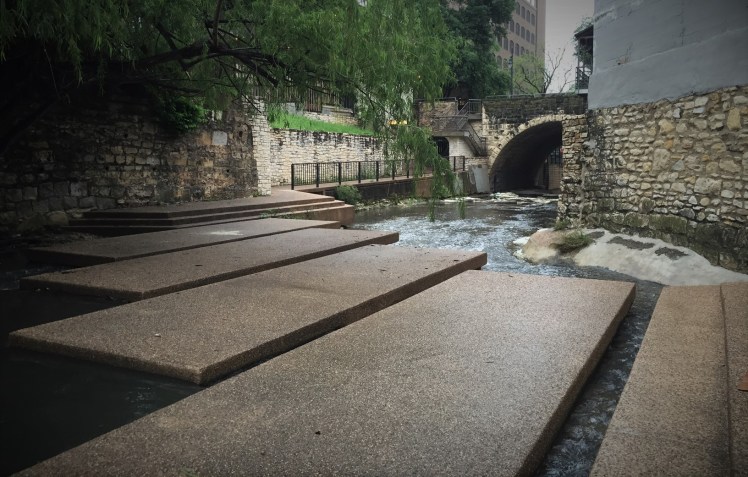
The night of April 30 is traditionally known as “Witches’ Night” throughout Europe. Festivals are still held to commemorate the occasion in Sweden, Germany, Finland, and others, providing a rich set of pagan practices to draw from, such as jumping over a small bonfire while making wishes for what one would like to manifest in the coming year.
For those of us on the left hand path, April 30 is the anniversary of the founding of the Church of Satan in 1966 – making last night the big 5-0. Despite the rift of separation between the Temple of Set and the Church of Satan, most Setians feel it’s valuable to acknowledge and celebrate our Satanic heritage from time to time. One fantastic way to do so is to celebrate Walpurgisnacht, in which we can overlap pagan practices with whatever Satanic rites we might like to Indulge in (see what I did there?).
Last night, the Bull of Ombos Pylon met on the banks of Waller Creek in downtown Austin. While working with the idea of permanence, endurance, and preservation, we also sent forth a blessing to the Temple’s newest Pylon – Black Rivers Pylon of Ottawa, ON – brought into Being on the same night.
Those of us who are fortunate enough to be able to Work with other Setians face to face have a special understanding of the power of the living Temple, and the importance of personal interaction. It is through this kind of Work that the words and works of the Temple will endure.
Eternamente.
Xeper.
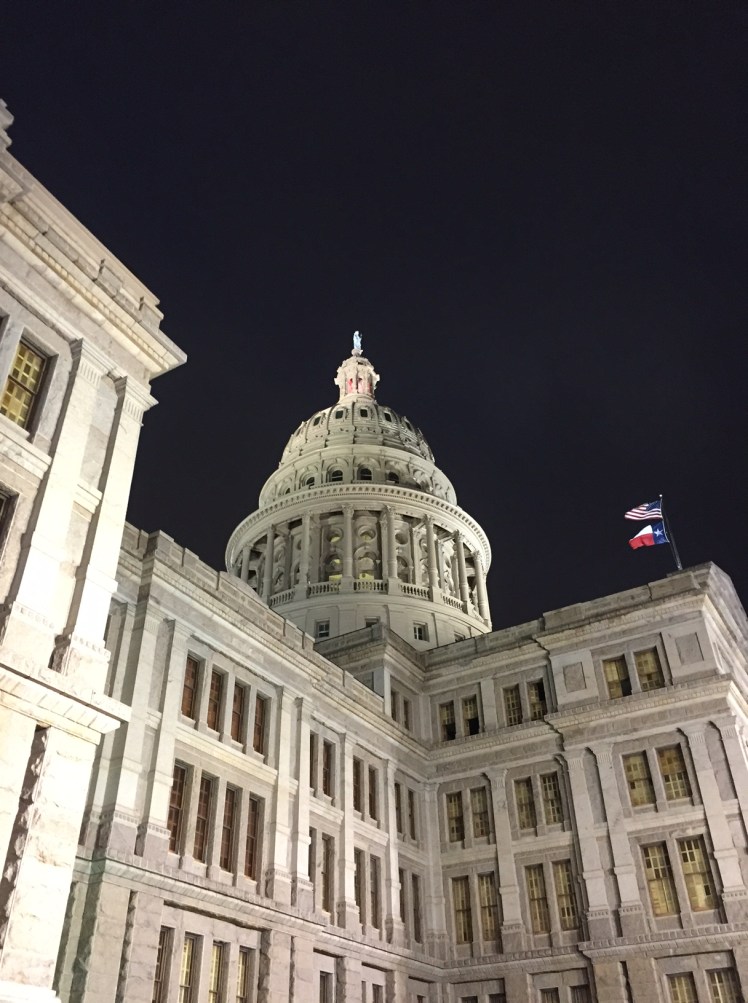
One of the stated goals of the Bull of Ombos Pylon is to engage and strengthen the magical current of Austin and Central Texas. So, while meeting in someone’s living room is all well and good for a while, eventually it’s good to branch out, look for a change of scenery, and find locations that call to our inner hellraisers.
Although Texas has a reputation for right-wing politics, good-old-boy Christianity, and guns guns guns, in reality, the attitude here is very much “live and let live.” In my many years of affiliation with the Temple of Set, during which I’ve performed countless Workings in public places (and not just in liberal Austin), I have encountered zero instances of interference from members of the public. At the most, people will generally curiously watch for a moment, then lose interest and walk away. The key here is to act natural! We’re not breaking the law, and there’s no reason to skulk around as if we’re doing anything wrong. Acting sneaky will only attract unwelcome attention.
In choosing locations, there has always been a visceral, intuitive calling that led me to good spots. I’ve used Google (“best meditation sites in Austin”), word of mouth, or just stumbled across some amazing places. The Texas State Capitol building has been a place that we’ve returned to again and again, as it has tremendous magical potency. It has been declared a sacred site to the Temple of Set and the Bull of Ombos Pylon, and our magic is now a part of it. The Pylon and the Temple are strengthened by the energy of the Capitol grounds, and will continue to be for as long as the Setian current resides in Austin.
In just the last couple of years, we’ve also performed Workings on the downtown boardwalk, standing under one of the original remaining moonlight towers, at the top of Mount Bonnell, and under a freezing full moon at Mayfield Park. As Austin continues to reveal herself to us, I know we will discover even more incredible sites in which to sow the seeds of our magic.
 XeperAustin