Dark Reminiscence

The following is a guest post by Pylon member Nachtreisander, sharing his unique perspective of our beautiful city.

Gateway

In Austin and the areas surrounding it, hidden waters run deep and dark. When I first moved to Austin in the early ’90s, I quickly became aware that the city seemed to be a magnet for certain types of individuals, who like myself were seeking things that seemed less easily attainable elsewhere.  “Finding oneself” is not unique to the young, nor is Austin the only city that attracted people who wanted to live unconventionally, but it sure seemed like early ’90s Austin was one of the major destinations for individuals interested in breaking from the pack, to explore different ways of thinking and living.

I was still in the very early years of my own magical journey, having absorbed a few years of random new agey, occultnic gobbledygook, before rejecting most of it. I entered my early 20s realizing that I didn’t know much about anything, except that the goofy combination of Wiccan beliefs and ’70s bookstore mysticism that I’d previously (and eagerly) embraced seemed like bullshit. But I felt pretty strongly that magic was real. Some of it sure seemed to work, and I’d settled into a comfort zone of being a LaVeyan style Satanist, for lack of finding a better fit. I never bothered with joining the Church of Satan, as it didn’t seem necessary to me. LaVey’s written works were simple enough to digest, and I didn’t need help getting laid, or a new social environment. I didn’t feel like I wanted to belong to an organized group of any kind at that time. But LaVey’s ideas were simple and refreshing, in that they were relatively lacking of the kinds of claptrap that made other magical systems off-putting to me back then. Satanists believed in magic, but seemed more concerned with living a fulfilling life in the real world, and that resonated strongly with me.

I’d grown disillusioned with crystals and chakras, and I wasn’t interested in replacing the creepy, jealous God of Abraham with Mother Nature either. That growing discontentment with the new agey, white light style of spiritual revolt that seemed to be dominant in occult circles I was privy to paralleled a feeling of running against the wind in other areas of my life. I lived in Houston at the time, and while I was comfortable there, I was also bored.

Boredom is a strange feeling, as it can indicate that a person needs to open their eyes and work to find things that stimulate them. It’s a bourgeois obstacle much of the time. Boredom is often a problem with being too comfortable with an unchallenging state of being. It certainly was for me at that time. I began to feel like I needed to get out of town and see what experiences other places might offer an oddball like me. I suggested to my roommate that we should check out Austin, which was only a three hour drive, and had a reputation as being a more bohemian town than Houston. Neither of us had ever spent any significant time there, but after making a day trip  to the Capitol City, I quickly began making plans to move there, shocking my roommate and most of the people I socialized with. I’d sensed that Austin was the right place for me, and within a month I was living there, knowing only a small handful of people.

Austin in the early ’90s was still a magical place, both literally and figuratively. For young people, or the young at heart, it was on a short list of cities where being a weirdo was OK. Rent was cheap, there were plenty of crappy low effort jobs available, and it seemed like the perfect place to run to if the pressures of other cities and mainstream culture had gotten you down. Consequentially, a LOT of people flocked there from all over the country, looking to forge their own version of the pursuit of happiness. The city had a transient feel, and still does, being a melting pot of people from all over the country. Meeting the occasional Austin native was rare, and felt like spotting a unicorn, but it didn’t matter. Sure, some of the aging hippies bitched about how things were falling apart, but Austin still seemed like a place where being strange wasn’t detrimental, and could actually be a positive personality trait. I took to the town like a fish to water, and it was definitely a case of being the right time and place for me.

In the first few years I lived there, I began to have a growing awareness of a mostly hidden current that runs through Austin, and it’s one that can be an extremely creative catalyst for certain individuals, but it can also destroy others. Austin is built on and from that current, but like magic itself, tapping into it comes with certain risks.

While it’s true that people who live fast often die young, that seems doubly true here in Austin. Time and time again, I saw people who were drawn here almost as if to a beacon, to ride a high wave of success or creativity for a few years, only to meet sudden and abrupt ends. In other cases, the city’s reputation as a paradise for slackers led to many naive folks mingling with dangerous people who moved here to victimize or exploit them. Part of that can be explained simply as growing pains, as a city explodes in population, and goes through changes as a result, but to me, there has always been a lot of danger in Austin, just barely hiding under the surface, and it eats up those who are unaware or ill-equipped to handle it.

But that danger and the city’s dark nature is also exhilarating and empowering to individuals who approach it with caution, and who are comfortable working with dark currents. People who naturally suspect that the smiling hippie guy they’ve met at a party might also aspire to be the leader of his own death cult are probably also suited to working with the magic that is native to this place. One should be prepared to encounter some hard truths along the way, and to face the sometimes uncomfortable need to discard things along the path of self transformation. Moving to Austin was one of several events that created massive changes in my life, and the dark nature of the town has continued to inspire and transform me. I changed into a person that grew dissatisfied with Satanism, although to a much lesser extent than other magical systems I’d encountered previously. Its use of Satan as a symbol of personal sovereignty and rebellion still rings true, but it became unsatisfying to use an Abrahamic boogieman once the fun shock factor wore off. So, what I have Become is deeply tied to Texas, but especially Austin.

More on this at another time…

The Ten Commandments

To commemorate the closing of 2015, Brother Virgil created a fantastic Working of personal and universal transformation. The members of the Bull of Ombos Pylon performed this Working on the grounds of the Texas State Capitol Building on the night of December 12, 2015.

What follows is an edited version of Brother Virgil’s commentary and the text of the rite.  The theme of the Working was “Planting the seeds of Liberty.”

**********************************************************

In brainstorming ideas, I kept finding myself thinking about “the end of the beginning.” That concept was more of a Year XLIX thing initially, but I’ve found it to be especially relevant this year, and it may be there’s a bit of a time overlap thing going on. And that makes me think about the pivot points of long story arcs in our lifetimes (and Initiation for the Initiated), the paths that have led each of us to the present moment. There comes a point when you look back and think about all the ways you’ve grown, the things you’ve put behind you, and the things you’ve meant to get rid of, but for whatever reason, keep hanging around.
Sometimes, like the Serpent, we have to shed our skin so our new form can emerge in its fullness.
What skin do you have to shed? Maybe the change has already taken place and needs to be commemorated; maybe it’s a choice that’s been put off for too long and it’s time to take action. But there is Liberty to be found in freeing ourselves of what was once a hindrance… a habit, a toxic entanglement, a counterproductive belief or mindset. And Adept Black Magicians know the formula and its power. The Liberty we win by overcoming our hindrances is an end in itself. But the lessons we’ve won through our transformations can also serve as a Gift to those not yet aware of the power at their fingertips through the very existence of the Gift of Set.
So where am I going with this? Stay with me a second…
We’ve used the Magic of Place many times at the Texas State Capitol campus.  If there is any place in America that needs the Fire of Liberty to break the grip of Restriction, could there be a more fitting place than Texas, a state notorious around the world for its embarrassing theocratic politicians and strongholds of toxic Christian Nationalism? (“Texas” is slang for “crazy” in Norway; did you know that?):
Sure, Austin is a whole other scene, a sanctuary of sorts, and nothing about Texas is as black and white as it seems to outsiders; our Pylon knows this all too well. But the truth of the matter is, beyond the relative sanity and “coolness” of Austin the preachers and churches still hold way too much power over otherwise decent people who have been sorely misguided by the toxic culture they’re soaking in, and don’t yet realize they have other options.
There are those, of course, who grow sick of the toxic elements of this host culture and act out about it.
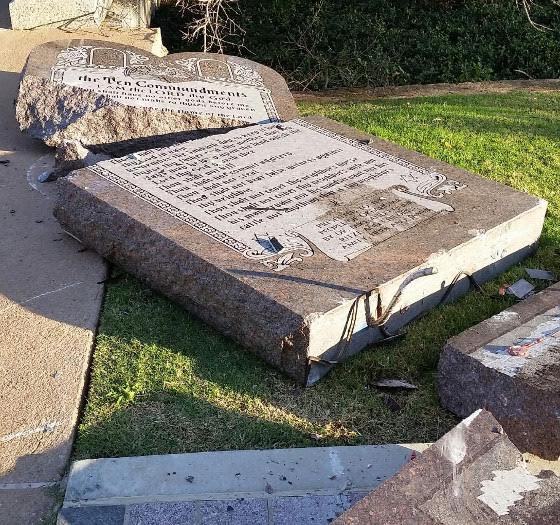
FLASHBACK: October 2014. An Oklahoma man claims Satan told him to destroy and piss on the monument of the Ten Commandments at the Oklahoma State Capitol:
ten commandments 1
Take a look at that monument. Look familiar?
TenCommandmentsAustinStateCapitol
Abbott
Turns out the Oklahoma monument was a replica of the one found in Texas. The Texas monument was donated to the state by the Fraternal Order of Eagles at the encouragement of Cecil B. DeMille (yes, the Ten Commandments movie guy):
Even the most basic research on the origins of the state capitol Ten Commandments monuments comes back with hit after hit of news stories about the controversies generated by these monuments being placed on public government property.
Now, we all know the monument of the Ten Commandments at the Texas State Capitol is highly unlikely to come down during our lifetimes, as much as we might like it to, and as much as an insult it is to secular governance and the separation of church and state. Even if we weren’t the law-abiding citizens we are, the investment-risk-reward ratio of an attempted “black op” against the monument on the State Capitol campus doesn’t even make sense on paper. Even if we “succeeded” somehow in destroying or stealing it we would fail, as publicity surrounding such an act would only feed into the phony “Christian persecution” narrative so beloved by the preachers and churches.
So…
What might happen if the monument of the Ten Commandments at the Texas State Capitol were permanently and irreversibly consecrated to the Powers of Darkness, a monument ablaze with the Black Flame, inspiring consciousness, curiosity, intelligence, and evolution in all who encountered it, a power source spreading the Black Flame like cobwebbing blood vessels in all directions of the map, spreading its influence deep into the surrounding regions, gradually weakening and undoing the strongholds of tribal narcissism and anti-intellectualism once and for all?
All that said, please find my proposal below:
**********************************************************
WORKING
– Gather and decompress at the Capitol monument. Take a good look at this object and observe your emotions. What does the presence of this thing say to you? What does that say about your relationship with your host culture? What would you change about it if you had your way?
– SILENT BELL and INVOCATION: When the time seems right, begin slowly walking in a counterclockwise circular path around the Capitol building. Go at a leisurely pace, individually and by your own path; no rush. “Sound” 9 bell chimes or other fitting markers of the Working’s beginning by the power of your Will alone. Then radiate the Invocation of Set or an Invocation of the Dark Powers as guided by your own genius; again, by your Will alone. Blaze with the Black Flame within you. Feel the vast stores of your yet untapped power coursing through your body as a consequence of the Gift of Set.
– SILENT SUMMONING OF THE ELEMENTS: As you journey around the Capitol in your heightened state of Being, reflect again on all that has led up to this point and the skin you intend to shed (or have shed already). Examine both the past and the future in light of your place here in the present moment. What are the lessons of your transformations? What does the future hold? What next? During this time, you may summon or connect with whatever godforms, daemons, or manifestations of the Dark Powers most resonate with your Work. But summon them silently, again by the power of Will alone.
– SACRIFICE: Complete the counterclockwise circuit around the Capitol, returning at last to the monument of the Ten Commandments. Look upon it for the last time, for from this day forward, this object of stone will be forever transformed, as you yourself will be. Symbolically shed your skin as guided by your own genius, then offer your shed skin at the feet of the monument, that it may serve as “kindling” to set the monument ablaze with the Black Flame.
– TRANSFORMATION: Summon your utmost power and consecrate the monument of the Ten Commandments to the Powers of Darkness, permanently and irreversibly transforming it into an inexhaustible battery engulfed in the Black Flame, spreading the fire of consciousness, curiosity, intelligence, and evolution in all who encounter it, spreading its influence far beyond the city limits into the surrounding regions and beyond. For so long as this monument exists, its existence now empowers the Aeon of Set and corrodes the grip of Restriction and the god of Moses upon the hearts of humanity, in spite of the lies etched upon its surface.  The following Statement is recommended to finalize your act:
“Set is mightier than the god of Moses.”
– Reading from the Statement of Azazel:
“But on Earth, where man wandered in mindless bliss, the firmament blazed forth with fiery tongues, and all the land was covered by the Black Flame, which burned not, though it bewildered the eye to see it.
“And Raphael and his guardian Angels were dismayed, for nowhere could they see man or the spirit which had come to him. Then did Raphael call upon Michael to strike the Black Flame with the force of God, but even then was the Flame vanishing of its own accord. And at first it seemed that Earth was unchanged, but in the eyes of man did Raphael see the first gleam of thought.”
– Personal Work as required
– CLOSING: “So it is done, and so it begins.”

Seeking Mystery

Sekrit 2

One of the most beloved ideas in the Temple of Set is that of Runa.  Runa is a call to seek the mysteries, to explore and discover unknown territories.

Runa is an incredibly dynamic Word. By definition, it cannot be static because we are always learning and finding new things.

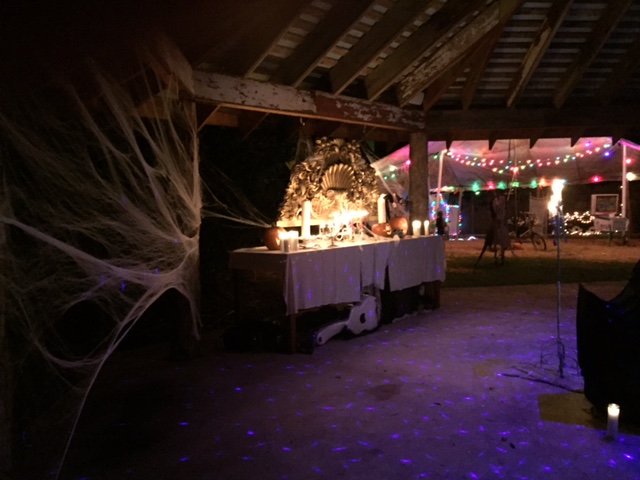
It is no surprise to me that Texas is Runa’s birthplace. My city is home to a great many mysteries, oddities, strange and beautiful places just waiting to be experienced. I was fortunate to discover a new place on Halloween night, a magical space of play and imagination, nestled into an unassuming residential neighborhood on the outskirts of town.

It’s these moments that shock the system, and wake us up to the magic that’s really everywhere. Every moment is an opportunity to create something magical. It’s not what you do, it’s who you are.

Here is a lecture by Dr. Stephen Flowers on the subject of Runa.

Answers from Brother Virgil

In reply to our first question, Bull of Ombos member Brother Virgil had this to say:

Q: What made you decide to join the Temple of Set?

A: After years of struggling to “cinch” my beliefs into the Baptist teachings I’d been raised on in spite of the obvious evidence of verifiable reality, I cancelled my subscription to Christianity in my mid-20s. Reading Gavin Baddeley’s Lucifer Rising: A Book of Sin, Devil Worship, and Rock & Roll confronted me with the question that changed everything: “If I’m calling myself a Christian, why is everything I’m into in a book about Satanism?”

At that point I was ready to read LaVey’s Satanic Bible with a truly open mind. It was a powerfully liberating experience for me, but I hesitated from just trading off one set of dogmas for another. I adapted the ideas from Satanism and Chaos Magick that resonated with me, but never bothered to join any groups, or even to perform any magic rituals. For me, it was all about sorting out what my values really were as opposed to those my host culture had implanted in me. That, and of course letting go of all the silly hangups about my sexual desires the Christian churches had shoveled into my head.

Science worked fine for explaining the rules of how things work in material space-time. Atheism worked fine for explaining how the preachers and churches are full of shit. But alone, they inevitably started tripping up when they started trying to talk about things that weren’t scientific. They still didn’t address the questions of human spirituality: Science tells me what I’m made of, but what am I really? What is my deal going to be with the world around me and the people in it? What can I be? What should I be? But on the flip side, no one school of religion or spirituality seemed to have a lock on what was really going on in the world either. Pre-monotheistic paganism held the romance, magic, and archetypal appeal of human myth and wonder, but was admittedly just as obviously made-up as Biblical stories of talking snakes and pregnant virgins. Abrahamic monotheism, i.e., Judaism, Christianity, and Islam all derived from a common root in unsupported claims that were false and mistaken in principle, even before taking their long history of genocide, holy war, restriction, and empire into account. Hinduism was colorful and interesting, but showed no signs of being ahead of the curve from any other world religion. Buddhism seemed benevolent on the surface, but its denial and negation of human Desire struck me as conceptually impossible in theory and viscerally repugnant in practice.

But somebody, somewhere, had to have some idea of what was really going on. Somebody had to know that Abrahamic monotheism was part of the problem, not the solution. There had to be some kind of real resistance underway. Somebody had to at least be close!

For a time my beliefs drifted in a sort of Twilight Zone between atheism, Satanism, neo-paganism, Asatru, and my understanding of the Left Hand Path as discovered through online research. I was hip-deep in occult theory and speculation. I even joined Dragon Rouge, a Left Hand Path magical order operating from Northern Europe. But nothing I encountered could translate all this theory into a coherent picture of how I could actually use it to start taking control of my life.

All this time I had been aware of the Temple of Set, but had not given it a serious look beyond second and third-hand accounts from others. Going back to the openly-available writings of Michael Aquino, Stephen Flowers, and Don Webb gave me a fresh perspective that really crackled for me. For once, a picture of what a magically vital whole experience might be – here in the real world that actually exists – began to emerge.

And so I allowed my Dragon Rouge membership to expire and sent an inquiry to the Temple of Set’s Executive Director. One of the best things I ever did, hands down.

Brother Virgil’s Tumblr can be found here.

More Thoughts from Setians

In the interest of fairness, my own answers to our questions –

(1) What made you decide to join the Temple of Set? 

I’d been interested in black magic for some time, but my life was a mess. I knew several people who were members, and they all carried themselves with a quiet confidence, and really seemed to have their lives together. I vowed to myself that someday, when I had some measure of success, something to show for myself, no matter how small it seemed, I would see about joining.  Finally, about twelve years ago, I had finally started work in my chosen field, left a bad relationship, and was starting out on living life on my own terms. I felt that it was time, and asked for sponsorship from one of my friends. The rest, as they say, is history.

(2) What do you recall of your earliest impressions of the Temple? 

Before I joined, the Temple seemed really intimidating. Almost to the point of being monolithic. I knew it was for people who were very smart, successful, and extremely serious about the Work of Becoming a god. I wondered if I could ever measure up and take my place among them.

After I’d finally mustered the courage to try it, I found an incredible warmth and sense of welcoming. People were open and friendly, and even the most celebrated Ipsissimus were approachable and kind. I remember wanting to read and do everything out there, which is a common pitfall!

Now, so many years later, as a “Senior Adept,” I strive to remember how I felt in those days any time I interact with new Setians. It’s a crazy, heady, mind-blowing time. Every little, tiny interaction seems to have such huge significance. It helps to maintain a sense of perspective.

An Interview with Uncle Setnakt

Set Is Mighty

It is Man the Magician who leads humanity toward the Unknown. Magic seeks to translate energies from one state of existence to another in accordance with an intention of the operative intelligence. So does science. The difference between Magician and Scientist lies in methods and materials, which sometimes are not so dissimilar as might appear. A circle-dance and a cyclotron have much in common. The symbolic tools of Magi and Mathematician both operate through Inner dimensions to cause Outer effects.

Modern science has evolved far more ritual procedures in its techniques than ancient magicians ever dreamed of, and they all come from the same source- Man’s curiosity concerning the Cosmos and what he has to do with it; human attempts at growing into Godhood. Ritual is a major tool of Magic and science alike for patterning the consciousness of its operatives so that calculable results may be obtained. Unhappily is it’s a sadly neglected tool, ill cared for and misunderstood.

-Badiou, A. Peut manuel d’inésthétique.

Meeting Setnakt was strange.  I had expected a man that names him self after a XXth Dynasty Egyptian Pharaoh, Setnakt “Set Is Mighty,” to have Egyptian jewelry or tattoos.  Or worse yet, to have a Gothic aesthetic that would have matched a man thirty years his junior.  Instead he wore an Hawaiian shirt and gifted me with the current issue of Fantasy and Science Fiction, in which he had a story.  After he got his chai and made small talk about the dryness of Austin weather, we got down to business.  He broke off occasionally to meet other people in the coffee shop, and had a tendency to wander off into Austin stories.  “All Texans are story tellers.  Texas is a continuous magical narrative that we tell ourselves. Like all sorcery, ten percent sublime Truth and ninety percent bullshit.  We only have problems with Texans that forget the ten percent like George Bush.”  He asked me to send him transcripts by e-mail so that he could be more accurate with his quotes.  “I have a reputation of being smart.  Sadly that may not be in the ten percent.”

Per Setnakt’s request, I allowed him to make frequent use of capitalization, which he feels reflects the archetypical nature of the topics discussed, and I feel reflects a clinging to occult style.  We disagree where additional capitals lie in the ten-ninety percents.

Q: How is Setian magic different than other magical systems?

A: Setian magic is about managing synchronicities.  Setians, like most Western magicians since the Renaissance are Neo-Platonists.  We see change in the Subjective Universe, the realm of Forms, produces change in the Objective Universe, the realm of common perception.  We understand that Desire is the key to changing the realm of Forms, and that the manifestation of that change is an event with at least two “edges.”  One edge is the effect on the Subjective Universe – how does the magician feel and think about herself and the Cosmos after the event has occurred and the either edge is the effect in the Objective Universe.  Take a simple example, Setian Boniface needs some money to go to Conclave.  He creates a prosperity rite.  He chooses the language of American Hoo Doo, for various personal reasons.  He might just as well have used Runic magic, or sigil creation, etc.  The rite conveys information to his unknown self – the timeless self that exists outside of the manifest realms.  His desire has been strong and the unknown self sends a message back.  One side of this message is overhearing a great job opportunity while waiting in his dentist’s office, another side is having the confidence and daring to act on the overheard information.  He gets the job – and this affects him in many ways.  It creates a sense of empowerment, it causes him to grow more disciplined in manner, it causes him to deal with some of his baggage by being exposed to a new emotional environment.  On the Objective edge it gives him more money, opportunities for professional growth and an airplane ticket to Munich.  The event isn’t a simple “make a wish and get a treat” happening, it changes him and requires balance and artistry to incorporate the change into his life.  The Setian realizes that Initiation may be defined as thinking the right thoughts at the right time, puts great care in managing these synchronicities – she knows the “dangerous” side of Black Magic (that is to say magic done for the Self) comes in the moment that she sees her own Will manifesting inside her and beyond her.  The Setian differs from the Chaos magician (and most Thelemites) that “belief is everything.”  The Setian does believe that Truth exists and that it is invariant, however she does not believe in a single method to learn Truth by.  Setians must engage in what French philosopher Alain Badiou calls “truth-processes” – methods by which the self acquires truth.  Badiou lists Science, Art, Love and Politics – to which the Setian would add Magic. This is a Remanifestation of an older idea.  For example in the third book of the Picatrix there is an interesting dialogue (after an Apotheosis spell!), where in Hermes asks Socrates how magic is like philosophy.  Socrates replies that it is “Perfect Nature” and goes onto explain that the Magician becomes aligned with his Perfect Nature (here seen as a planetary spirit) in the same manner the philosopher is empowered by Truth “It is this which opens the gates of the science, it is by this that the unknown is known, it is this which affects the open and hidden dimensions of the world. “  Our method reflects these same intents, which Aquino rediscovered and I have provided a firmer scholarly link to through the Work of the Order of Setne Khamuast.

Q: How does Desire play into Setian magic?

A: The Right Hand Path in its purest form – southern Buddhism – rejects desire as the force that causes the Self to believe itself separate from the Cosmos.  Dr. Aquino’s magical theology elevated Desire to a central role – in his Ceremony of the Nine Angles, he described the Ninth Angle as being a flame that burns to the glory of desire.  We embrace desire as the source not only for individuation but also for meaning-making.  As a consequence the Setian experience is one of gradually causing all lesser desires to be subsumed into one great desire for Becoming, of manifesting the sense of order of the unknown timeless self into the chaos of the this world. Each feat of Becoming is designed not to quench Desire but to lead to a state of functioning in which stronger and more complex desires may be obtained.  This differs from the Church of Satan’s immanent path where Desire is seen as an expression of a mortal being subject to carnal decay – such desires are fleeting and ultimately fail with carnal self.  The Setian seeks to refine and discover her Desire so that the Unmanifest part of her Self will exist in the realm of Becoming long after the physical part has failed.  One of the aspects of my High Priesthood had been to emphasize the importance of Life-work, finding a cause in the world that you infuse with your Will so that it serves your psyche much as the ancient Egyptian mummy was said to serve the Ka of its owner.  One of my experiments with this was my part in the Recognition of Lilith Aquino’s V* Word of Arkte, which consecrated her Life-work in the realm of animal protection into a vehicle of her Will that will endure on this world in ways much magically potent than simple fame (or an expensive tomb at Forest Lawn).  My use of her Work as a teaching moment of the idea of Initiation would be an example of VI* Work.

Q: What would you say are changes in the formula and practice of Setian Initiation that you brought into the Temple?

A: I draw much more strongly on anthropology and the social sciences than my predecessor did. In particular the work of Arnold Van Genep and Victor Turner. Genep provided a model of Initiation of Isolation-Liminality- Reintegration.  The Temple of Set, because of our roots in the Church of Satan, which emphasized hedonism and social criticism (reactions to the Society of the Spectacle), were very good at the first two steps.  Most Setians, horrified by the mindlessness and hypocrisy of society, had voluntarily withdrawn from it in some way – whether the simplistic adoption of a “Goth” or “Industrial” lifestyle or something as radical as subsistence farming.  Once the forces of the human macro-cosmos are withdrawn, the forces of the Self become manifest.  Strange things happen and the “Chinatown” phenomena that Robert Anton Wilson likes to write about.  In the liminal state the arbitrary rules of the intrasubjective universe are exposed as arbitrary, synchronicities abound and  magical might is confirmed by strange signals and omens. Setians tended to park themselves in this phase of the process.  They enjoyed weirdness for weirdness’ sake, which leads to two problems.  Firstly most Setians burned out after about four years, just wanting a “normal” life.  Secondly, there isn’t much power taking in Liminality.  You live paycheck-to-paycheck in your apartment at the beginning of the process and you are still there at the end of the process.  The third phase, Reintegration means you take your transformed self back into the world, working at a stronger and more complex level.  I helped Setians understand the goal of magic is not more magic, but to take areas of the world they initially loved but were estranged from.  Setians began much longer stays in the Temple, education became a more recognized goal.  Six percent of Setians have PhDs, which is a very different profile than when I joined and most Setians were college drop-outs (as I was at the time).  Victor Turner, a successor to Van Genep, talked about the effects of Initiation on groups.  Turner argues that groups of people that undergo initiatory processes at the same time form close bonds.  As High Priest I utilized this by announcing themes the Temple could work on.  I would choose broad open-ended ideas (like the Ankh, the Monolith, etc.) and encourage people to explore this ritually.  Strong friendships developed in the Temple and without any enforcement or manipulation from the leadership some of the economic synergy of Freemasonry came into being as well as a higher level of philosophical dialogue within the Temple. I modified the institutional structure of the Temple which had Pylons, groups of people exploring basic Setian Initiation (usually on a geographic basis) and Orders, groups of people that study and refine the Teachings of a Magister Templi, to also include Elements, group who co-operate in specialized study or coordinated social, political, cultural or magical actions upon the world.  Examples would include groups for musicians, writers, martial artists, women’s empowerment, graduate students etc.

Q: What was the effect of the Utterance of Runa in the Temple?

A: In the Year XXIV, the Council of Nine Recognized the Runa, Word of Magus Stephen Edred Flowers.  I had joined in XXIII and I was at ground zero.  The effects of Runa were huge and I would like to point three areas.  During my High Priesthood and especially in my actions of the Third, Fourth, Fifth and Sixth Degrees I strongly taught Runa in the Temple.  The three areas I wish to focus on are firstly that Runa ended modernist conceits that magic is undiscovered science, secondly Runa emphasized an objective balance to subjective inquiries, and thirdly Runa has emphasized objectivist results.

The Church of Satan’s aesthetic largely comes from Weird Tales and Unknown – Twentieth Century fantasy magazines fond of the “magic is undiscovered science approach.”  Since the Church of Satan emphasized magic as an expression of individuals rather than a tradition – magical theories did not involve traditional beings and forces.  Magic was thought of as energy liberated from the psyche and subject to scientific laws.  This differed little from New Age beliefs, and the Temple was attracted to the pseudo-sciences and simplistic popular metaphors of the seventies and eighties.  Flower’s simple observation that systems that had worked in the past would work again, partially drew attention to traditional approaches, and his academic background drew Setians to linguistic and anthropological theories of magic – particularly Dr. Stanley Tambiah’s linguistic model.

The Temple has always favored a subjective approach to the subjective universe, influenced by one of Aquino’s favorite philosophers arch-idealist Fitche.  The notion, which remains a central part of LHP  ideology, is that the best guide to me is me. However as humans we may shy away from what is painful to us, or difficult to understand because of lack of experience.  When a symbol system is chosen to help understand the daemonic and emotional selves, the magician must examine his blind spots. Flowers points out that symbol systems that have stood the test of time – the Runes or the Tarot for example – will alert the magician to lacking areas in his development.  If someone learning the Tarot says “I don’t get the Moon.” It points to a blockage in their nature that can be explored and addressed leading to both healing and empowerment.

Lastly the Runes as an historical artifact communicate across time.  Master carvers carved the stones, set them in public areas, and generations.  The notion of a masterpiece has become part of Setian culture.  The Temple had thirteen published writers when last I checked, unlike the days when it was Dr. Aquino, Dr. Flowers and me.  The Temple now also has artists with gallery shows, not just folks that show up at Conclave with pictures about the devil, jewelry makers, Setians creating retreats etc.

Q: What is your magical anthropology?

A: When I joined the Temple it relied strongly on Initiatory material from other systems. One of the books on our reading list was Peter Ouspensky’s The Psychology of Man’s Possible Evolution, which outlined a three center man – the stomach/physical center, heart/emotional center, and brain/mental center.  I changed this model and provided an approach for each of the four centers.  The carnal center is the physical body.  I suggested that it is firstly an altar to the psyche and that the Initiate must explore and broaden the ways her body can know pleasure.  Secondly taking a tip from Indian Left Hand Path (particularly Indian alchemy), I advocated finding forceful ways to reverse the processes of entropy, disease and old age.  This is physical antinomianism.  The emotional center are the emotions we have been trained to feel, plus those that arise from our authentic experience.  I advocated examining and removing material that is not your own, but which had been forced upon you using Crowley’s methods to pairing images and sensations with their opposites.  For your own material seek to deepen it, and taking a tip from Assagioli’s  Pyschosynthesis work to make sure your emotions follow you, not that you follow your emotions.  The intellectual center needs training in logic and critical thinking on the one hand and training in creativity and lateral thinking on the other.  The average person attracted to the occult is not a critical thinker, since the magical state is not a rational one; this has lead to the sad state of the occult sciences these days where to be a magician is (justifiably) equated with being a gullible fool.  The daimonic center is the result of such magic as you have perceived coming into your life.  The other three centers may be said to exist in three parallel lines.  We often mistake a emotion for a bodily sensation, or an idea for an emotion because we have not learned to be self observant.  The daimonic center may be seen as line running orthogonally to the other three.  I advocate increasing the daimonic center through play and observation.   The daimon of ancient Greece was seen to be a being below the perfected gods, but beyond the limits of humankind.  When the daimonic center is aligned for self-evolution and powered by a love of magic all other centers (if working properly) will flourish in many ways – getting mysterious boosts from an interesting and beautiful life.  My four-fold system also helps Setians understand the lack of coherence in the self, and the need to Self Create the Self.  Xepera Xeper Xeperu.

Q: What do you mean by your statement that “Magic is a Truth process”?

A: Most religious and philosophical systems understand that humans begin in ignorance. We are given a model of the world based on sense perception, received ideas and notions deliberately crafted to make us feel or “think” in a certain way at a certain time. In our postmodern world there is no central paradigm that holds intelligent people together.  When one stands against such a world by asserting that one’s own reality is more authentic than the spectacles presented to us, intelligent people are presented with the choice of assuming either there is no reality save what we believe, or that Truth is hard to get at.  Chaos magicians choose the first, we the choose the second.  Setians distrust pre-packaged realities (even those coming from other Setians) – so you can’t hand them a text and say “read this!”  Setians are given a Need.  In order for their magic to Work they must discover real principles behind themselves and their cosmos in order to know what changes are possible and what are the most efficient  methods of achieving those changes.  The Setian seeks Truth he can verify by experience because each Truth leads to an empowerment of the Self – “Perfect Nature” from the Picatrix above.  Humans have several areas wherein the process of dealing with ideas — Seeking after Forms – can yield Truth to them.  Among the Truth processes are Art, Love, Science, Politics and (for the Setian) Magic.  The “Truths” yielded by the processes are experiential Truths.  For example you can understand when I say, “It is better to have loved and lost then never  to have loved at all.” However if you have had the experience alluded to in the words, your understanding is based on gaining Truth, if you have not had the experience, your understanding will be an intellectual one only.  Truth processes expose the psyche a reflection of itself that bridge more than level of the four-fold human.  At times the Truth processes of different sorts may come into a play – a successful love spell may yield Truth in the realms of both Magic and Love.  Badiou calls these moments “sutures” when you gain Truths that hold you together.  I prefer the Setian term Remanifestation, which refers to the deeper re-experiencing of a state already known on some level of being.  These moments knit the human together, and can be seen as a personal manifestation of Ouroboros or Leviathan.

Q: How are Gurdjieff’s Work and the idea of “sutures” related in Setian practice?

A: Gurdjieff ‘s great gift to the Left Hand Path is to point out that the “Self” does not exist of its own. He helped make human aware that rather than a single Will working upon itself and the Cosmos, humans are a bundle of little wills.  Such a collection makes change impossible on the human level – and the notion of immortality more of a curse than a promise.  Gurdjieff used exercises in precision and self-awareness cutting across the human centers to create an artificial sense of Self that might grow into true Self with time and continued effort.  My method is to use ecstatic perception of Truth to unify the parts of the Self.  Unlike Gurdjieff I propose there is a Self, however Unmanifest, that communicates with its Remanifested parts, mainly through Wonder.  In Gurdjieff’s system humans must find a School that directs the correct energies (Shocks) that wield the parts together.  In my system only those humans who by self-grace have begun their own Self-Creation can be aided by the School.  Neither I, nor the Temple of Set, can teach a Self to Self-Create, we see this as a holy mystery, the Gift of Set.  I teach that it is possible to pursue certain activities in the presence of others with similar pursuits and useful situations can arise that lead to the moments of suture.  Just as a the Setian learns to manage synchronicities, I have taught methods of group work to the Temple of Set that lead to large numbers of humans experiencing those synchronicities at the same time, and therefore being able to have meaningful dialogue about them in a greater community dedicated to discussing methods of self advancement in all forms from financial to spiritual to health, etc.

Q: What is the Work of the Order of Setne Khamuast?

A: The Order is named for the world’s first Egyptologist and librarian,  Ramses II’s fourth son – Set-Is-Beautiful, A Power Manifests in Thebes, I began my magical order at a Working with the Order of the Trapezoid in the British Museum.  The aim of the Order is to reclaim workable Initiatory and magical formula from Egyptian, Middle Eastern, Greek, Mesopotamian and African sources.  Dr. Flowers has a three fold method which he used to remanifest the runic systems: Objective Analysis, Subjective Synthesis, Enactment.  I added a fourth element Teaching.  My students look for the best data they can find on a religious or magical system.  Once they feel they have understood the system in its own terms, they take what they find beautiful and recreate in culturally meaningful terms for their current needs, then they enact the magical system until they get results.  Lastly they must teach what they have done – firstly inside the Temple and then into the greater world.  Some have published as Setians, others choose to put forth their findings in other ways – for example essays in archaeological journals or even in Left Hand Path training manuals that do not have the TOS imprinter.  Others still have made their fourth phase of manifestation art and video.

One example of the Order is my best-selling The Seven Faces of Darkness, where I took the spells involving Set-Typhon from the Greek Magical Papyri and reworked them for use for the modern magician.  On the one hand it provided a good basic spell book, but on a deeper level it enabled a modern human being to experience the magical essence of Set in the contest of his life while understanding how this essence has expressed itself through time.  The historical aspect of the Work of the Order gives the Self a suture that only comes from understanding that the world the Self is manifesting into is conditioned by those very magical currents that awakened their daimonic centers to start with.  Using historical magic not only claims for the  Self the very forces that made it, it Teaches the Truth of Self-Creation.  This sort of suture, this experience of magic as a truth process, can only come through reenactment.

Q: What is the purpose of your Initiatory writing?

A: The simple answer is to find people who are undergoing the Xeper process and help them find the Temple of Set. Self-Creation is always, at first, a daimonic affair.  When you begin going against the stream of the world, you are attracted to images of revolt.  This is your daimonic center awakening you.  For example when Europe began its Renaissance, it wasn’t merely reason that created the new way of looking at the world.  On a daimonic level the images of the old gods were needed – for a good example of this see Godwin’s The Pagan Dream of the Renaissance. People need certain images and magical formulae to ease the Need their daimonic centers possess – and unless that need is met with a blend of intellectual and emotional supports you simply have human beings in pain that spend a few years spray painting the word Satan on the backs of buildings until their fire of self dies down and they become the dead souls that maintain the world of illusion.  Most of the people that read my books won’t seek out the Temple, but depending on how the great Need for my darker memes are, they will spread these ideas into the world – on the one hand making more art and material for Setians to draw from and on the other contributing a more free society that supports the notion of Self Creation, which is the long-term goal of the species whether you see it as Nietzsche’s Over-Man or Ken Wilbur’s integrated  human.  Setians may get there first, but my love for mankind prompts me to help other get there to.  In this I reflect the Will of my Patron. Great Is The Might Of Set, And Greater Still Through Me.

Thoughts from Setians

In the spirit of beginnings, and opening the Way, I recently posed a pair of questions to the members of the Bull of Ombos.

(1) What made you decide to join the Temple of Set?
(2) What do you recall of your earliest impressions of the Temple?

Kansas22 had this to say –

(1)The Temple of Set was the “last stop on my shopping list.” From the very first two interviews I heard, this group seemed to have greater insights into existence, history, and SELF growth that no other place had, or at least not sharing openly. In both the interviews I liked the “style” and angle from which they spoke. Giving information about the Temple, what it was about and what it meant, and leaving it there for the listener to pursue or turn away from. They didn’t force feed or preach to anyone, they knew that the knowledge IS the reward and that they don’t have to market it or pitch it. There was 3 main points that stood out to me most.
1. Provided insights that answered questions I had, but also gave additional avenues for me to study
2. Reading the initial information that I did, transformed ME and MY thinking, putting ME in a different frame of MYnd that allowed me to comprehend things differently that I had before
3. It emphasized SELF!! I can’t spotlight enough how much I enjoyed this aspect. I can work on my own or in a group. And I loVed the Temple is Set up to where one has the opportunities and access to others great knowledge, information and insights, but the “group” portion doesn’t distract, take away from the individuAL.

The “worst” thing about The Temple of Set is that the more you research, the more you want, and the more the crAVings and hunger grows! Which I feel is a testament to how much the Temple incorporates, but also the potentiAL for what the Temple can be and Xeper in to.

(2) I first heard the name, “Temple of Set” back in the Fall of 2001. I did not research them, or know much more than a couple of lines about them~ but EVEN THEN I “felt” that they could quite possibly have information that most places did not have, but also that they may have an entirely different take on this whole “life and existence thing.” The fact that they were not a main stream organization, and did not have a “franchise” in every town added to my initial theory of them, but also confirmed a credibility to them.
By the time 2013 rolled around and I was able to listen to those two interviews (Ipsissimus Aquino, podcast interview/ Ipsissimus Flowers, youtube interview) I felt that they were both highly, highly intelligent, and very well thought-out. And that is putting it mildly! They gave a lot of great information, but also made me feel that there was a lot more~ to them as people, as Temple Members, and to the organization as a whole.
Cynosurematic replied –

(1)

I had been seeking the mysteries for a very long time and was finding it necessary to work within a school. There was a point in which I spread myself thin, doing philosophical work with one group, meditation with another, yoga with another, while still reading as many books as I could and making cross references to distill the essence and find the common ground. At the time I did not know the difference between right hand (RHP) and left hand path (LHP) and I like to think that the LHP found me. It was a friend from the philosophical school who suggested it and named three LHP schools worth exploring.

Choosing the Temple of Set was very intuitive, I made an educated guess from the information that was available. My main source of information about it was its website. The publicly available documents were not many but they covered a lot of ground and I found them comprehensible. I felt that their thinking sat well with my own ideas about spirituality and the human responsibility for personal development. However, I first had to decide whether the LHP was for me or not, and if I was made for the LHP. I explored the path generically and meditated about it for some time. An attraction started to grow as well as a certain sweetness felt whenever I connected with it. This is a feeling I can still easily summon and enjoy thanks to the memories of those days.

Once comfortable with the idea of exploring the LHP, the choice of school fell from it as if by the same process of unfolding.

(2)

There was a lot of work to be done from the start, exactly what I was looking for.  I felt relieved that I had at last found a structure and guidance for my self work and decided to go all in.  The relief was short lived, though, when I started to apply the stuff.  The hardest part was to realize that it was I who was creating most of the content, the challenges, and designing the initiatory program I was embarking in.  I understood that, from this point on, I had taken the driver’s seat in all respects of my life.

After the initial awakening, things became confusing.  I really did not know where I stood when everything started to crumble and I had very little to build back with.  With intuition I started to build some experience and then it became evident that the resources provided were the tools for self work, not the answers to the many questions I had, which were the usual ones we fill our heads with while growing up and in reaction to our assimilation of contemporary human culture.  What I found was food for thought, inspiration, and ideas for further exploration in different realms, then I started to rebuild.

The initial results were learning to think independently, to disassemble contradicting beliefs systems, and to discover automatic thinking patterns.  After doing some polishing of the left brain, I got into right brain activities involving imagination and creativity.

Looking back, it is intriguing to see patterns in the chaotic process.  What seem to be independent bursts of actions and ideas separated in time and space, become like logical steps in a process that appears to be creating itself.  Then, you realize it is of your own doing, which is pretty neat.

Xeper!

A School for Gods

Let’s start at the beginning.  What is the Temple of Set?

It used to be very difficult to find information about the Temple, and rumors abounded and flourished in the days before the internet.  We live now in an incredible time of intellectual freedom, and so much that was once hidden is now out in the open.

In the simplest terms, the Temple of Set functions as a school and a source for black magicians to share resources, experiences, and research.  The flow of information goes not only from the top down, as you’d expect, but in all directions.

Several years ago, our founder, Dr. Michael Aquino, decided to make public one of the foundation documents of the Temple.  Because outdated and/or corrupted copies had been floating around online for so long, he felt it could only benefit the curious public, as well as the Temple itself, to make his essay “Black Magic” widely available in PDF format, for free.

“Black Magic” can be found here.

This document is the basis of Setian philosophy, and encourages questions and experimentation.  The Temple does not avoid questions that come from those who are truly seeking answers.

The Temple of Set is unique in that it not only allows, but requires that each Setian should only endeavor to become the best, purest, and most authentic version of themselves possible.  We seek to become gods and goddesses, and the Temple allows us the opportunity to learn from others who share our path, as well as enjoying the benefits of teaching.

One of my favorite aspects of my experience in the Temple, which now spans well over a decade, is the accessibility of its people.  It’s not a personality cult, and you won’t find any gurus.  Our highest-ranking and most esteemed members are often the most curious, open, and fun among us.

The official website of the Temple of Set can be found here.